
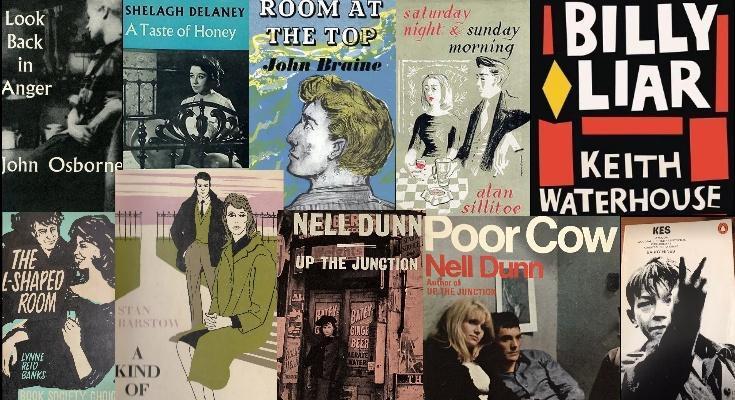
Kitchen Sink Realism Films Based on Influential Novels & Plays
“Kitchen Sink Realism” resulted in some pre-eminent novels, plays, and films that were to become timeless reading and were later adapted for the screen.. They were to capture the adversities and aspirations of working-class individuals in post-World War II Britain. Here are some of the most prominent of those “Kitchen Sink Realism” novels and plays that later went on to be adapted into films. The novels and plays are in date order of publication, along with a summary of their respective films that were released.
Look Back in Anger by John Osborne (1956)
John Osborne is regarded as one of the writers associated with the Angry Young Men movement, and Look Back in Anger was one of its defining works.. Whilst it is a play, it is of great influence in literature and film of the Kitchen Sink Realism genre. It is set in the Midlands and focuses on the life of its main character, Jimmy Porter, as he navigates through the disillusionment of his life and his failing relationship.
It explores themes of gender, relationships, and very evidently, class and the hierarchical education system. The play first premiered at the Royal Court Theatre, London, in May 1956.
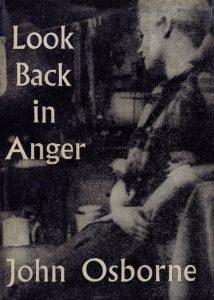
Published by Faber and Faber, 1957
Look Back in Anger (1959) – Directed by Tony Richardson
In 1959, Look Back in Anger was adapted into the film of the same name. It was directed by Tony Richardson and produced by Harry Saltzman and Gordon Scott. It stars Richard Burton, Claire Bloom and Mary Ure.
Look Back in Anger (1959) – Title Sequence
HD Retro Trailers
Jul 23, 2018
Room at the Top by John Braine (1957)
Room at the Top is set in the fictional Yorkshire town of Warley. It centres around the ruthlessly ambitious protagonist, Joe Lampton. Joe comes from strong working-class roots; however, he has aspirations to escape his roots by ascending the social ladder. It explores class struggles, love and sex, and the detriment of success at the expense of personal relationships and what is morally right.
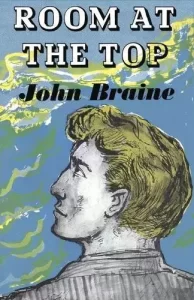
Cover artist John Minton
Published by Eyre & Spottiswoode, 1957
Room at the Top (1959) – Directed by Jack Clayton
Adapted into the film in 1958, Room at the Top was directed by Jack Clayton and produced by John Woolf
and James Woolf. It stars Simone Signoret, Laurence Harvey and Heather Sears.
Room at the Top (1959) – Original Trailer
Jun 6, 2019
A Taste of Honey by Shelagh Delaney (1958)
Written in 1958 by Shelagh Delaney at the age of 19, A Taste of Honey is regarded as a milestone play. Whilst, like Look Back In Anger, it is a play, it is of great influence in literature and film of the Kitchen Sink Realism genre. Equally, it is also one of the most prominent works of the Kitchen Sink Realism literature genre. Set in the working-class area of Salford, a district in Manchester, the central character is the teenage Jo.
The predominant focus and central theme of A Taste of Honey is Helen’s abandonment of her role as her mother at the expense of Jo’s emotional well-being. A Taste of Honey also explores themes of family dynamics, class, race, gender, and sexuality.
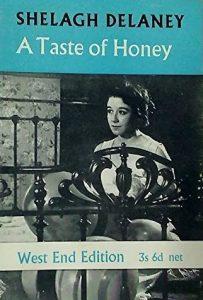
Paperback front cover, Methuen’s Modern Plays, 1959.
A Taste of Honey (1961) – Directed by Tony Richardson
A Taste of Honey was later adapted into a film in 1961. It was directed and produced by Tony Richardson. It stars Rita Tushingham, Dora Bryan, and Murray Melvin.
1961 A Taste Of Honey Official Trailer 1 Woodfall Film Productions
Feb 12, 2020
Saturday Night and Sunday Morning by Alan Sillitoe (1958)
Based in Nottingham, Saturday Night and Sunday Morning by Alan Sillitoe is one of the more popular of the Kitchen Sink Realism novels, focusing on the rebellious, defiant, and charismatic Arthur Seaton who works at a bike factory. He is disillusioned and equally frustrated with his working-class constraints as well as societal expectations.
This was prevalent within working-class lives after World War II. His own philosophy is “Don’t let the bastards grind you down”. It explores the themes of relationships, abortion, and the frustrations and rebellion against the tediousness of working-class life.
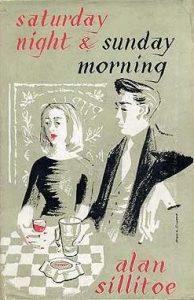
Cover artist: Mona Moore. Published by W.H. Allen Ltd
Saturday Night and Sunday Morning was later adapted into a film in 1960. It was directed by Karel Reisz and produced by Tony Richardson. It stars Albert Finney, Shirley Anne Field and Rachel Roberts.
Saturday Night and Sunday Morning (1960) – Directed by Karel Reisz
Feb 13, 2020
Billy Liar by Keith Waterhouse (1959)
Billy Liar is the novel penned by Keith Waterhouse and was first published in 1959. The central character is Billy Fisher, and the novel is set in the fictional town of Stradhoughton in Yorkshire. Billy works as a clerk in an undertaker’s office.
He spends much of his time trying to escape the boring routine of his life by fantasising, daydreaming, and concocting a variety of lies. Mostly to shirk any responsibilities that come with having a family and a job.
Billy wants to escape the ‘fishbowl’ existence in the small town of Stradhoughton and become a writer. He aspires to leave it all behind and head for the big city lights of London. Unfortunately for Billy, he is so caught up in his lying that he doesn’t quite see the bigger picture. Billy Liar explores the themes of societal expectations, escapism, relationships, and the generation gap.
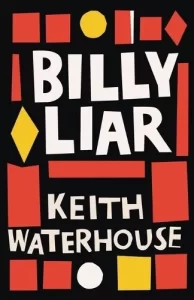
In 1960, Billy Liar was later produced as a stage play and opened in the West End of London. It was co-written by Keith Waterhouse and Willis Hall. The character of Billy was played by Albert Finney.
Billy Liar Directed by John Schlesinger (1963)
Billy Liar was also later adapted into a film in 1960. It was directed by John Schlesinger and produced by Joseph Janni. It stars Tom Courtenay, Julie Christie, and Wilfred Pickles.
Billy Liar Official Trailer
Dec 23, 2014
The L-Shaped Room by Lynne Reid Banks (1960)
The L-Shaped Room was written by Lynne Reid Banks and published in 1960. The novel tells the story of the central character and protagonist, Jane Graham. Jane becomes pregnant after a short affair, but chooses to keep her baby. Whilst she is from a middle-class neighbourhood and lives with her affluent family, she feels unsupported. Therefore, she decides to choose to rent a room in a boarding house in a run-down area of London.
The room is L-shaped, hence the title. It represents Jane’s living circumstances due to her taking the unconventional path of single motherhood. At that time, frowned upon by society. Here, she meets a mixed bag of individuals who become her fellow lodgers within the house. All of them have varying unique stories, and each is grappling with their own personal demons and adversities.
The L-Shaped Room is an empathetic novel and a symbolic work of feminist literature. It identifies and explores the grittiness of working-class life as well as dealing sensitively with issues of single motherhood. Highlighting how single motherhood was once perceived by society, and the social stigma and social isolation associated with it.
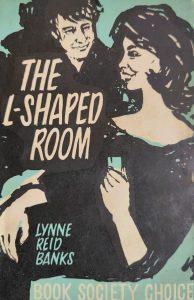
Cover artist: Una Bishop. Publisher: Chatto & Windus.
The L-Shaped Room Directed by Bryan Forbes (1962)
In 1962, The L-Shaped Room was also adapted into a film. The screenplay was written and directed by Bryan Forbes. It was produced by Richard Attenborough, Jack Rix and James Woolf. It stars Leslie Caron, Tom Bell and Anthony Booth.
The L-Shaped Room (1962) Trailer
fauxlimey
25 Feb 2014
A Kind of Loving by Stan Barstow (1960)
Set in the fictional industrial Yorkshire town of Cressley, the narrative of this novel centres around the life of the grammar-school-educated Vic Brown and his working-class background. Appearing fairly content with his lot, unlike that of Jimmy Porter in Look Back in Anger and Arthur Seaton in Saturday Night and Sunday Morning, Vic isn’t angry.
He, however, is very conflicted due to his attraction to Ingrid Rothwell, a typist whom he begins to date, who works in the same department of the factory where Vic is a draughtsman. The novel explores themes of relationships, unplanned pregnancy, and societal expectations.
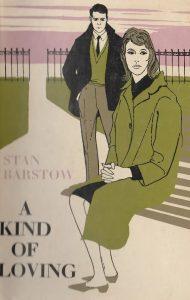
A Kind of Loving, Directed by John Schlesinger (1962)
A Kind of Loving was later adapted into a film in 1962. It was directed by John Schlesinger and produced by Joseph Janni. It stars Alan Bates, June Ritchie, and Thora Hird.
A Kind of Loving – Trailer
Rialto Pictures
Mar 29, 2017
Up the Junction by Nell Dunn (1963)
Up the Junction, along with Poor Cow, are two of Nell Dunn‘s most prominent works that contribute to the genre of Kitchen Sink Realism novels. First published in 1963 and Nell Dunn‘s debut novel Up The Junction is a collection of short stories is a collection of short stories. A series of vignettes offering a snapshot of the lives of the characters living in and around Battersea in South London.
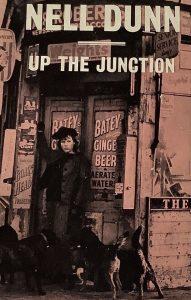
It mainly charts the lives of Rube and Sylvie and their friend Lily. All of whom work in a sweet factory. It follows their everyday lives and those characters intertwined within the predominantly working-class community of Battersea in the 1960s, and where they spend their weekends socialising Up the Junction, referring to Clapham Junction. Up the Junction explores the themes of social class imbalance and the detrimental consequences that can result in social isolation. It equally highlights the difference in gender roles within relationships, as well as the ramifications of illegal abortion.
The Wednesday Play – Up The Junction Directed by Ken Loach (1965)
On November 3, 1965, Up the Junction was broadcast, based on Nell Dunn‘s novel, as part of The Wednesday Play series. It was directed by the acclaimed director Ken Loach for his ground-breaking and commendable portrayal of Social Realism, and produced by James MacTaggart. The cast includes Carol White, Geraldine Sherman, Vickery Turner and Tony Selby.
Up the Junction Directed by Peter Collinson (1968)
Up the Junction was later adapted into a film in 1968. Peter Collinson directed the film, and the screenplay was written by Roger Smith. The producers were John Brabourne, Anthony Havelock-Allan and Harry Fine. It stars Dennis Waterman, Maureen Lipman, Adrienne Posta and Suzy Kendall.
Up The Junction 1968 Channel 4 promo 1986
Throwbacktvads
19 Apr 2021
Poor Cow by Nell Dunn (1967)
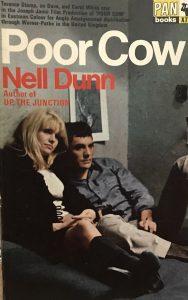
Poor Cow by Nell Dunn was published in 1967. The story concentrates on the central character of a young married mother, Joy, who lives in working-class London. Joy is married to an abusive, petty criminal and is stuck in an unhappy marriage. When her husband is jailed, she befriends her husband’s friend Dave, who is a more understanding and caring man.
Unfortunately for Joy, her happiness is short-lived when Dave also ends up in prison. Searching for love, happiness, and financial stability, Joy finds herself maneuvering through the harsh reality of poverty, transient relationships, and promiscuity. The novel, Poor Cow, highlights the themes of poverty and class struggles, as well as abusive and toxic relationships.
Poor Cow Directed by Ken Loach (1967)
Poor Cow was adapted into a film also in 1967. It was directed by Ken Loach and produced by Joseph Janni and Edward Joseph. It stars Terence Stamp, Carol White and John Bindon.
Trailer – Poor Cow (1967) – @britishfilmsandtv
Evandrus
23 Apr 2024
A Kestrel for a Knave by Barry Hines (1968)
Based in a South Yorkshire working-class mining town (and filmed on location in Barnsley), the story follows the young protagonist, Billy Casper. Billy is a young boy who has a very difficult life both at home and at school. He suffers from neglect in his home life as well as struggling at school. Because of this, his teachers take little interest in him or his well-being. His bleak reality is made worse further due to the repressive and stiff upper lip attitude within that community.
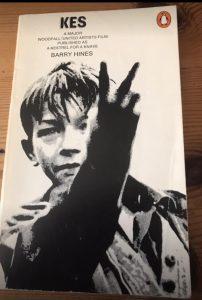
One day on a walk through the countryside, Billy discovers the nest of a Kestrel containing chicks. He takes one of the chicks home, and he calls it “Kes”. He goes on to form a bond with Kes, and this gives Billy a sense of solace and an escape from his everyday life. Billy’s relationship with Kes helps him to reclaim his dignity within the community that many times appears indifferent and shows little care for the adversities he is experiencing. A Kestrel for a Knave explores the subjects of the struggle of the working class in its relation to poverty, family dysfunction and social inequality.
Kes Directed by Ken Loach (1969)
A Kestrel for a Knave was later adapted as the film Kes in 1969. Based on the novel by Barry Hines, it was directed by Ken Loach and produced by Tony Garnett. The cast included David Bradley, Brian Glover, Freddie Fletcher, Lynne Perrie and Colin Welland.
Kes (1969) Original Trailer
HD Retro Trailers
Dec 18, 2017
This article discusses some of the more popular and more well-known Kitchen Sink Realism novels and plays and the films that were adapted from them. It is an ongoing archive, which I intend to add lesser-known works from my collection, as well as further British New Wave and Social Realist cinema.
© 2025 – 2026, Jayne Thomas. All rights reserved.
Follow me :