

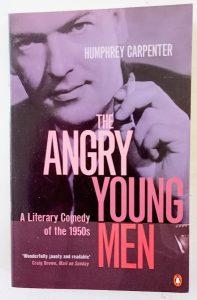
The Angry Young Men: A Literary Comedy of the 1950s by Humphrey Carpenter Review
The Angry Young Men: A Literary Comedy of the 1950s by Humphrey Carpenter was published in 2002. It is a biographical study of the writers associated with Britain’s ‘Angry Young Men’ movement of the 1950s associated with Britain’s Angry Young Men movement of the 1950s. Humphrey Carpenter concentrates on writers including Kingsley Amis, John Osborne, John Braine, John Wain and Colin Wilson. He also discusses the influence of other individuals. These writers drove the cultural shift in drama and literature in post-war Britain.
Rather than presenting the movement as a merged and unified collective, Carpenter explains that the term “Angry Young Men” was largely originated from and promoted by journalists to define writers from differing backgrounds and with differing personalities.
The book provides a portrait of Britain’s changing attitudes towards class, educational opportunity and traditional authority.. It is a very well-researched and comprehensive book that integrates biography and literary history as well as adding social commentary. Carpenter’s book is notable for its humour, satire and irony. It portrays Britain’s Angry Young Men movement as a mélange of rivalry, ambition, ego, publicity and authentic literary accomplishment.
The Angry Young Men: A Literary Comedy of the 1950s by Humphrey Carpenter – Synopsis
Educational Opportunity
The book begins by chronologically describing the backgrounds of the writers associated with the Angry Young Men movement. Many of the writers came from working-class or lower-middle-class backgrounds. They benefited from increased educational opportunities after World War II. Grammar schools and universities offered routes into higher education as well as literary culture that had previously been less available to people from these backgrounds. This was once seen as a privilege of the upper classes only (Britannica, 2025).
Kingsley Amis Meets Philip Larkin
The narrative follows the recognition of these writers during the 1950s, beginning with Kingsley Amis, coinciding with his friendship with Philip Larkin, whom he met whilst studying at Oxford University. Following the success of John Osborne’s Look Back in Anger in 1956, the movement gained wider publicity. This was the emblematic beginning of the movement.
Carpenter discusses how journalists and critics quickly began to establish the recognition of a new generation of independent trailblazers who questioned the apathy towards the class rigidity of post-war Britain. However, Carpenter repeatedly, at the same time, presents that the supposed movement was not a cohesive unity. Carpenter clarifies that the writers were not a closely unified group; some barely shared an acquaintance, while others openly disliked each other (Carpenter 2003).
Kingsley Amis, John Osborne and Colin Wilson
Kingsley Amis emerges as witty, skeptical and deeply cynical of intellectual pretension. John Osborne presents a public image which is temperamental and confrontational, associated with his youthful anger more than many of his peers. Colin Wilson, whose overnight success following the publication of The Outsider was soon followed by critical ridicule, is depicted as an eccentric outsider, however very likeable and very well read (Carpenter 2003).
Comic Quality
Carpenter presents these literary lives alongside public controversies, rivalries and affairs which give the narrative a noticeably comic quality. The later chapters describe the disintegration during the 1960s of the Angry Young Men movement.
Some of the writers later went on to become included within the establishment they had once condemned, while others faded from glory. Carpenter evaluates and concludes that the Angry Young Men movement was a more media-driven cultural moment that considered the wider tensions in British society and less of a literary movement (Britannica, 2025).
Class and Social Mobility
A prominent theme of the book is how British class structures changed after the Second World War. Many of the Angry Young Men writers came from modest backgrounds and observed traditional British institutions with resentment or distrust. Their writing voiced their frustrations with elitism, inherited privilege, and the limited opportunities available to ordinary people (Britannica, 2025).
Also because of changes in educational reform, this arose in the opportunities available for many of these writers to attend universities and enter literary culture. However, some experienced a sense of isolation within these new educational and literary environments. Carpenter validates and communicates this very well in the book. This sense of alienation became a determining feature of their literature and equally their public images.
The Media and Literary Celebrity
Another prominent theme within the book is the relationship between their writing and the media. Carpenter examines how the Angry Young Men were one of the first literary genres to be extensively molded by the newspapers, publicity campaigns, and celebrity culture. The term Angry Young Men stemmed mainly from promotion by journalists as journalistic slang. It did not derive from any formal manifesto or from an organised movement.
The book proposes that the media concurrently developed and misrepresented the reputations of this collective of writers. Public fascination with these “angry” young intellectuals often obscured the literary works they produced. Carpenter presents the occurrence as an early instance of modern media culture changing these writers into public personalities.
Masculinity and Rebellion
Carpenter also examines the effects of masculinity within the movement. The writers displayed images of toughness, disrespect, and anti-establishment defiance.
Their works regularly feature male protagonists frustrated by social expectations and emotional limitations. Carpenter also presents the insecurity and immaturity behind some of their rebellious public images. He often injects humour within his book to do so.
Importantly, the book also recognises that the movement was very much male-dominated, even though female writers such as Doris Lessing and Iris Murdoch were at times associated with it.
Literary Myth-Making
Carpenter frequently questions whether the Angry Young Men ever truly existed as a merged cultural group. Instead, he depicts the movement as a loose and temporary framework, shaped by publishers, critics, and journalists who were looking for a dramatic story about post-war Britain.
By questioning this, he offers a wider critical analysis of how literary history is not only shaped by artistic achievement but often by publicity and cultural fashion.
Critical Review
Carpenter’s book has been widely praised for its comprehensibility, humour, and the lively writer portrayals. As a biographer, he has the skill to reshape the personalities of the literary period with boundless enthusiasm.
The book succeeds very well in capturing cultural anxiety, ambition, and the vibe of post-war literary Britain. One of the key strengths of the book is that it does not glorify the movement.
Instead of the overly simplified belief in a unified collective of rebellious writers, it displays a more nuanced picture of clashing egos, opportunism, and fame that came accidentally. Thus allowing readers to see the Angry Young Men as flawed and somewhat contradictory individuals. Importantly, they remain not just stand-alone literary icons. Some critics maintain that Carpenter concentrates very much on gossip and narratives at the expense of advanced literary analysis.
Reviews also acknowledge that the book sometimes does not emphasise the importance of the Angry Young Men as a cultural transformation, but rather as a social comedy (Wesker, 2002). Others have pointed out that Carpenter has downplayed the long-term importance of the challenge to class hierarchy by the movement.
Nonetheless, the book is an enjoyable read in terms of both cultural commentary and literary history. Also noteworthy is that Carpenter successfully indicates how the Angry Young Men’s work reflected the arrival of new social voices.
Conclusion
The Angry Young Men: A Literary Comedy of the 1950s by Humphrey Carpenter is a riveting and incisive study of one of the most reviewed literary sensations in modern British culture. He presents them as a varied and somewhat dynamic collection of writers. All shaped by post-war social change and media attention. It combines biography, historical analysis and humour. Therefore, it is a well-researched book and a good introduction to the literary culture of the 1950s.
Carpenter illustrates how the movement revealed the anxieties surrounding British class structure, masculinity and education in post-war Britain. He also exhibits their lasting impact on British fiction, theatre and public discussion.
Equally demonstrating that the Angry Young Men captured the frustrations and inconsistencies of a changing society. Thus concluding that their influence facilitated British literature to open up to new voices. Additionally, the importance of their new social viewpoints corresponding to modern life during the era.
References
Britannica (2025) ‘Angry Young Men’, Encyclopedia Britannica. Available at: britannica.com (Accessed: 7th May 2026).
Carpenter, H. (2003) The Angry Young Men: A Literary Comedy of the 1950s. London: Penguin Books.
Wesker, A. (2002) ‘That sinking feeling’, The Guardian, 14 September. Available at: theguardian.com (Accessed: 7th May 2026).
© 2026, Jayne Thomas. All rights reserved.
Follow me :