

Saturday Night and Sunday Morning (1958) by Alan Sillitoe – Review & Synopsis
Saturday Night and Sunday Morning (1958) by Alan Sillitoe is a novel that is highly regarded as one of the prominent works of British Kitchen Sink Realism. The novel depicts the aspirations and frustrations of working-class youth in the late 1950s and was published during a time of cultural shift in Britain (Lodge, 1971).
Set in Nottingham, the novel follows its rebellious protagonist, Arthur Seaton, a young factory worker employed at a local bicycle factory. It portrays an unpolished narrative of working-class life, shaped by limited social mobility, routine labour, and a desire for personal freedom. Often associated with the collective of writers who disputed social hierarchies and tensions within post-war British society known as the “Angry Young Men”, Saturday Night and Sunday Morning became an important novel within the wider cultural movement of the period. (Carpenter, 2002).
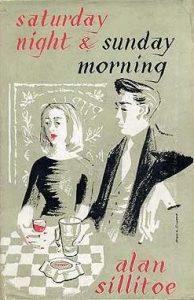
Cover artist: Mona Moore. Published by W.H. Allen Ltd
Synopsis of Saturday Night and Sunday Morning (1958) by Alan Sillitoe
The novel centres on its protagonist, twenty-one-year-old Arthur Seaton.
Arthur works as a lathe operator in a local bicycle factory, where he earns a steady wage but spends long hours performing repetitive work. Although his job provides financial security, Arthur finds the routine of factory life restrictive and monotonous. He responds to these frustrations with defiance and a refusal to conform. Arthur openly rejects conventional respectability that is expected of him, and is openly hostile towards authority.
Arthur Seaton’s Routine
Arthur’s life revolves around working throughout the week, with him looking forward to “Saturday night”. Thus representing the escape from the confines of the strict routine of factory life. It’s during the weekend he drinks heavily in local pubs, pursues sexual relationships, and engages in confrontations and fights. All of which are a temporary respite to release the frustrations of his working week. In contrast, “Sunday morning” represents the reflection and consequences of his “Saturday night” behaviour.
Arthur and Brenda
A central theme conflict of the story is that Arthur is having an affair with Brenda. She is the wife of Arthur’s co-worker, Jack. Evidently, there are risks involved for both Arthur and Brenda; however, Arthur continues nonetheless with the affair, having little thought of any potential consequences that may arise. Adding another layer of complexity, Arthur also develops a connection with Brenda’s sister Winnie. It is indicative to the reader that Arthur has a reckless approach to life. Plus, he refuses to stick to conventional moral expectations.
The situaion is then gets worse before it gets better when Brenda finds herself pregnant. Abortion being illegal at that time in Britain, Brenda attempts to end her pregnancy by surreptitious and dangerous means. This particular part of the novel highlights the drastic social consequences due to the few choices available to women at the time who embarked on extramarital affairs and sexual relationships outside of marriage. Arthur’s portrays an indifferent attitude to the pregnancy, by which the reader can see he is, in effect, shirking responsibility.
Arthur Meets Doreen
At the same time, Arthur meets Doreen Greatton, whose personality is the polar opposite to that of Brenda. Doreen symbolizes a woman who follows the traditional path of courting, marriage, and domestic stability. In the early stages of their relationship, Arthur portrays his usual self by coming across with a laid-back attitude to this relationship. However, as the relationship develops with Doreen, he realises that she can offer a much better alternative to his chaotic lifestyle.
Arthur’s irresponsible behaviour begins to catch up with him when Winnie’s husband discovers the affair. This results in Arthur being assaulted. This forces Arthur to reflect on his past behaviour, and he begins to re-evaluate his future.
At the end of the novel, we see Arthur choosing a more stable life with Doreen. The story ends with the proposal that marriage and domesticity may provide a new and better direction for Arthur. However, Arthur still exhibits his dissatisfaction towards social institutions and the rigid class structures that affect his life.
Working-Class Life
Saturday Night and Sunday Morning presents a detailed portrayal of working-class life in post-war Britain. This is one of the most prominent and distinguishable characteristics of the novel. Alan Sillitoe‘s drew on aspects of his own background and experiences in Nottingham. Much of the narrative of his stories regards his origins, growing up in Nottingham, factory work, local communities, and pub culture (Scott, 2016)..
The novel avoids idealised portrayals of working-class life and focuses on the everyday life of work, financial constraints, and social expectations. The industrial setting of the factory is central to the story. Factory work dominates Arthur’s daily life and contributes to his sense of restriction. Whilst employment can result in security, it can also represent a structure that discourages individuality and ambition (Scott, 2016).
Anti-Establishment Attitudes and Rebellion
Saturday Night and Sunday Morning is often associated with the writers described Angry Young Men, and the character of Arthur Seaton is defined by defiance of authority. Like the protagonists Joe Lampton and Jim Dixon created by John Braine and Kingsley Amis, Arthur challenges authority and middle-class values.
Arthur’s rebellion is mostly personal rather than political. He does not offer an alternative political ideology or a route for social change. Instead, his own individual resistance takes on the form of defiance, asserting his independence by drinking, embarking on illicit relationships, and fighting.
Escapism and the Structure of Time
The title of the novel reflects the repetitive pattern of Arthur’s life. The working week represents routine, discipline, and financial necessity, while the weekend offers temporary respite. However, this freedom is ultimately short-lived. Every “Saturday night” unavoidably results in a reflective and often uncomfortable “Sunday morning.” Arthur’s attempts to escape the social pressures of everyday life do not fundamentally change his circumstances (Sillitoe, 1958).
Masculinity and Identity
Arthur’s behaviour reflects aspects of working-class masculinity frequent in mid-twentieth-century Britain. This includes physical toughness, sexual confidence, and resistance to authority. Confrontation and fighting form part of Arthur’s rebellious nature; his actions also reveal his frustration with the restrictions of everyday life. Therefore, his behaviour is a disguise for his insecurity and frustration.
Moral Ambiguity and Social Constraint
A significant feature of the novel is that it does not morally judge Arthur Seaton as either entirely admirable or entirely unsympathetic. Instead, he is portrayed as a complex character shaped by the social conditions he is surrounded by and his own choices. The limited opportunities available to working-class youth add to his feelings of frustrations that define him. In this way, Saturday Night and Sunday Morning explores the relationship between personal responsibility and class inequality (Sillitoe, 1958).
Review of Saturday Night and Sunday Morning (1958) by Alan Sillitoe
Saturday Night and Sunday Morning is an important novel in the development of post-war British literature. Its success contributed to the growing prominence of social realism in late-1950s British fiction. It was a main contributor to a wider cultural shift towards a more direct representation of working-class life. Alan Sillitoe’s writing style is noted for its regional setting, colloquial language, and portrayal of everyday life experiences (Lodge, 1971).
An example of this is a narrative that represents regional dialect, thus creating a strong sense of authenticity and place. Alan Sillitoe’s approach to writing introduces the reader to a world that moves away from earlier British novels, which concentrated on the middle-class characters and experiences (Scott, 2016).
Arthur Seaton became one of the best-known working-class anti-heroes in post-war British fiction. His memorable, unapologetic nonconformity and individualism engaged the imagination of readers and helped establish him as a distinctive central character at a time when traditional social structures were increasingly being questioned.
Arthur Seaton’s Character
Arthur’s blunt, sceptical and often humorous personality also contributes to the novel’s distinctive energy.
Arthur’s decision to settle down with Doreen marks a significant change in his circumstances. However, the novel leaves open the question of whether this represents personal maturity or a move towards the conventional life he had previously resisted. As the novel concludes, it questions whether individual rebellion can truly defeat structural social limitations.
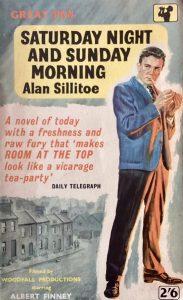
The success of Saturday Night and Sunday Morning was followed by its adaptation into a film of the same name in 1960, directed by Karel Reisz and produced by Tony Richardson (British Film Institute, n.d. ; Hill, 1986).
A Personal Reflection
My Initial Encounter (1986/Barnsley):
At sixteen, I read Alan Sillitoe‘s 1958 debut novel very much through the experiences of my own working-class background.. Living in the shadow of the South Yorkshire coalfields, I viewed Arthur Seaton’s “anti-hero” status through a lens of regional solidarity. The novel functioned as a declaration of working-class defiance. It felt like a raw portrayal of working-class defiance that reflected aspects of the atmosphere of mid-1980s Barnsley, where I grew up.
My Contemporary Re-evaluation (2026/Nottingham):
Today, my perspective on the novel has shifted towards its Nottingham setting and the character of Arthur himself. Initially moving to Nottingham in 1995, I lived in the adjoining suburb of Wollaton. It is within the immediate vicinity of the Raleigh factory site and Salisbury Street. The novel has therefore become, for me, not only a story about class but also one closely connected with the streets and industrial landscape of Nottingham.
I now view Arthur Seaton’s lathe-work not merely as hard work, but as an indicator of self-determination. From my scientific background, I instinctively feel it is more a reading of the cyclical pattern of working-class life—the “Saturday Night” hedonism vs. the “Sunday Morning” accountability. To me, this pattern is an important part of the way Sillitoe portrays Arthur’s working life and search for freedom.
Saturday Night and Sunday Morning serves as the foundational bridge in my forty-year collection, connecting the northern industrial world of Kitchen Sink Realism with the distinctive working-class landscape of the Midlands. It links my formative years in South Yorkshire to my later life in Nottingham.
In Conclusion
More than six decades after its publication, Saturday Night and Sunday Morning continues to be studied as an important portrayal of mid-twentieth-century British life. Its themes of identity, dissatisfaction and the search for personal freedom remain relevant today to the discussions surrounding class, youth and social change.
For me personally, the novel bridges the distance between the young student I was, first moved by Stan Barstow’s writing in the spring of 1983, and my move to Nottingham in 1995 to pursue my scientific career.
References
British Film Institute (n.d.) Saturday Night and Sunday Morning. Available at: British Film Institute film entry (Accessed: 23 August 2026).
Carpenter, H. (2002) The Angry Young Men: A Literary Comedy of the 1950s. London: Penguin.
Hill, J. (1986) Sex, Class and Realism: British Cinema 1956–1963. London: BFI Publishing.
Lodge, D. (1971) The Novelist at the Crossroads and Other Essays on Fiction and Criticism. London: Routledge.
Scott, J. (2016) ‘Midlands cadences: Narrative voices in the work of Alan Sillitoe’, Language and Literature, 25(4), pp. 312–327. doi: 10.1177/0963947016645001.
Sillitoe, A. (1958). Saturday Night and Sunday Morning. London: W. H. Allen.
© 2026, Jayne Thomas. All rights reserved.
Follow me :