
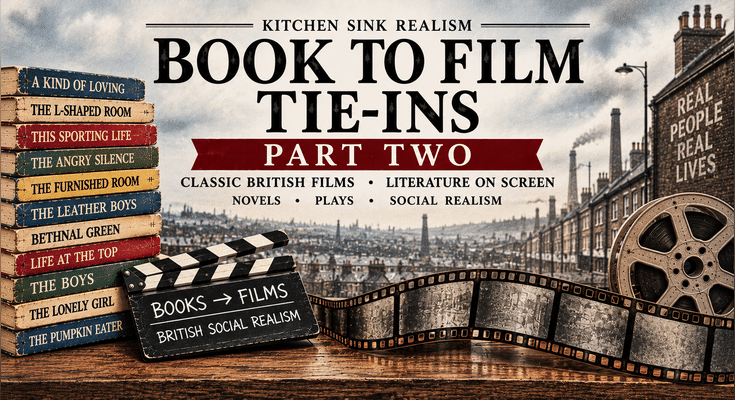
Kitchen Sink Realism Books & Film Tie-Ins – From Page to Screen – Part Two
Many Kitchen Sink Realism stories had already been told through novels and plays before finding their way onto the cinema screen. Through their writing, these authors explored everyday working-class experiences against a backdrop of rigid social divisions and a rapidly changing Britain. This section explores the literary works that inspired some of the most memorable films of the era.
11. 📖 A Kind of Loving (1960) by Stan Barstow
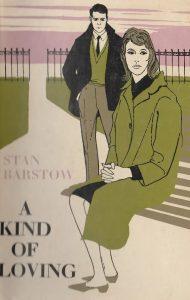
The novel follows Vic Brown, a young working-class draughtsman living in the fictional Yorkshire town of Cressley. He becomes involved with Ingrid Rothwell, a typist at the engineering firm where he works. However, when Ingrid becomes pregnant, their relationship takes an unexpected turn, leading to a marriage shaped more by circumstance than romantic commitment. Vic finds himself struggling with the responsibilities of marriage, his own uncertainties about love, and the expectations placed upon him as a young husband (Barstow, 1960; BFI, 2022).
🎬 A Kind of Loving Directed by John Schlesinger (1962)
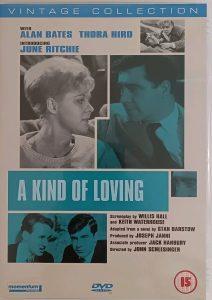
The novel was adapted for the cinema by director John Schlesinger, with the film released in 1962. The film’s screenplay was written by Willis Hall and Keith Waterhouse. Starring Alan Bates as Vic Brown, June Ritchie as Ingrid Rothwell and Thora Hird as Ingrid’s mother, the film was shot in and around Manchester and Lancashire. It received four BAFTA nominations in 1963 and won the Golden Bear at the 12th Berlin International Film Festival in 1962 (BFI, n.d.; BAFTA, n.d.; Berlinale, 1962).
Both the novel and film explore how social pressures, family expectations and concerns about respectability could push young people into marriages for which they were emotionally unprepared. Through Vic and Ingrid’s relationship, Barstow presents an honest portrayal of love, responsibility and the difficulties of navigating adulthood within the conventions of post-war working-class society (Barstow, 1960; BFI, 2022).
12. 📖 The L-Shaped Room (1960) by Lynne Reid Banks
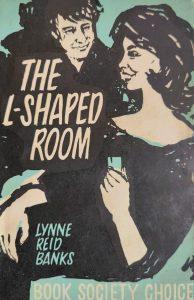
The novel centres on Jane Graham, an unmarried young woman who discovers she is pregnant and finds herself rejected by her family. Facing the stigma and social judgement attached to unmarried motherhood in early 1960s Britain, Jane moves into a run-down boarding house in Notting Hill. There, she encounters a collection of individuals from different backgrounds, each facing their own personal difficulties and experiences of social exclusion. The novel explores unmarried motherhood, prejudice, female independence and the search for self-respect and belonging (Reid Banks, 1960; BFI, n.d.).
🎬The L-Shaped Room Directed by Bryan Forbes (1962)
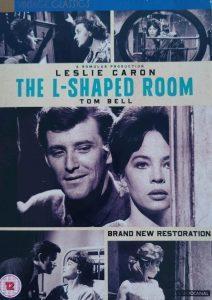
The novel was adapted for the cinema by Bryan Forbes in 1962, with Leslie Caron starring as Jane Fosset and Tom Bell as Toby. The supporting cast included Bernard Lee, Avis Bunnage, Pat Phoenix, Mark Eden, Anthony Booth, Nanette Newman and Emlyn Williams. Caron received an Academy Award nomination for Best Actress and won the BAFTA Award for Best British Actress in 1963. The film was also nominated for the Palme d’Or at the Cannes Film Festival (BFI, n.d.; BAFTA, n.d.; Academy of Motion Picture Arts and Sciences, n.d.).
Set against a backdrop of deeply ingrained traditional values regarding marriage and family, The L-Shaped Room provides a compassionate examination of the social stigma experienced by unmarried mothers. Both the novel and film highlight the importance of friendship, independence and personal dignity in the face of social prejudice (Reid Banks, 1960; British Council, n.d.).
13. 📖 This Sporting Life by David Storey (1960)
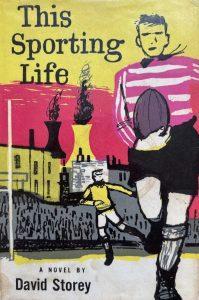
The novel follows Frank Machin, a working-class rugby league player from Yorkshire who achieves professional success through his strength and determination. However, his sporting achievements are overshadowed by his emotional frustration, loneliness and increasingly destructive relationship with his widowed landlady, Mrs Hammond. The novel explores working-class ambition, masculinity, violence, emotional repression and the limitations of material success (Storey, 1960; BFI, n.d.).
🎬 This Sporting Life Directed by Lindsay Anderson (1963)
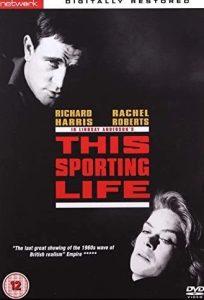
The novel was adapted for the cinema by Lindsay Anderson in 1963, with Richard Harris starring as Frank Machin and Rachel Roberts as Mrs Hammond. Both actors received Academy Award nominations for their performances, while Roberts won the BAFTA Award for Best British Actress in 1964. Harris also received the Best Actor award at the 1963 Cannes Film Festival. The film is widely regarded as a landmark of British New Wave cinema and an important example of Kitchen Sink Realism (BFI, n.d.; BAFTA, n.d.; Festival de Cannes, 1963).
Through both the novel and the film, working-class masculinity is shown to be restrictive: physical strength and athletic achievement may bring status, yet they cannot protect against emotional fragility amid deeply rooted expectations surrounding marriage and family. Through Frank Machin, Storey explores the conflict between professional ambition and the need for personal connection deeply entrenched (Storey, 1960; BFI, n.d.).
14. 📖 The Angry Silence by John Burke (1961)
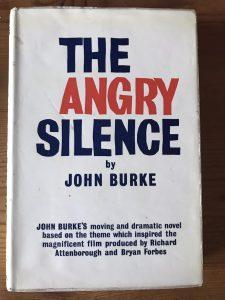
John Burke’s novelisation follows Tom Curtis, a factory worker who refuses to participate in an unofficial strike. His decision places him at odds with his fellow workers, leaving him isolated and subjected to intimidation and hostility. The resulting tension extends into his home life, as his family also experiences the consequences of his decision. The story explores working-class solidarity, individual conscience, industrial conflict and the personal cost of standing alone (Burke,1961; BFI, n.d.).
🎬 The Angry Silence Directed by Guy Green (1959)
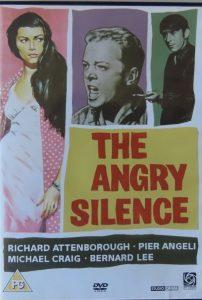
The original film was released in 1959 and directed by Guy Green. It starred Richard Attenborough as Tom Curtis, alongside Michael Craig and Pier Angeli, with Bernard Miles among the supporting cast. The film received several BAFTA nominations. (BFI, n.d.; BAFTA, n.d.; Rialto Pictures, n.d.).
The Angry Silence depicts the intense pressures that collective loyalty and workplace politics placed on individual workers in post-war Britain. As a British social drama, its lasting impact rests on how it examines personal conviction, social isolation, and the cost of breaking norms (Burke, 1961; BFI, n.d.).
15. 📖 The Furnished Room by Laura Del-Rivo (1961)
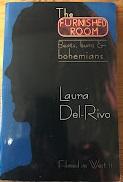
The novel centres on Joe Beckett, a young man who has left his provincial background behind to pursue an uncertain existence in London. Moving between furnished rooms and casual employment, Joe struggles with feelings of alienation, disillusionment and a lack of purpose. His experiences reflect the uncertainties of young working-class life in late 1950s London, where the search for independence and personal fulfilment is often overshadowed by loneliness and social isolation (Del-Rivo, 1961; Tredell, n.d.).
🎬 West 11 Directed by Michael Winner (1963)
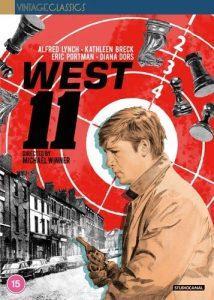
The novel was adapted into the 1963 film West 11, directed by Michael Winner and starring Alfred Lynch and Diana Dors. Relocating the story to a specific area of West London, the film retains the novel’s atmosphere of alienation and disillusionment, depicting the precarious lives and social isolation of young people in the capital (Del-Rivo, 1961; BFI, n.d.).
16. 📖 The Leather Boys by Gillian Freeman (1961)
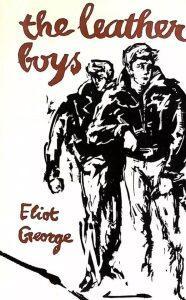
The novel centres on two young working-class men, Dick and Reggie, who become friends through their involvement in a motorcycle gang. Reggie, who is unhappily married to Dot, eventually leaves his marriage and moves in with Dick. Their relationship develops beyond friendship, challenging the social conventions and attitudes towards homosexuality prevalent in early 1960s Britain. The novel explores sexuality, working-class identity, social prejudice and the difficulties faced by those whose relationships fall outside accepted conventions (George, 1961; BFI, n.d.).
🎬The Leather Boys Directed by Sidney J. Furie (1964)
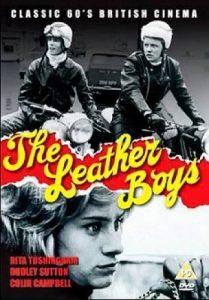
The novel was adapted into the 1964 film The Leather Boys, directed by Sidney J. Furie, with a screenplay written by Gillian Freeman herself. The film stars Rita Tushingham as Dot, Colin Campbell as Reggie and Dudley Sutton as Dick. It is regarded as an important landmark in British LGBTQ+ cinema for its sympathetic portrayal of a working-class homosexual relationship at a time when homosexuality remained criminalised between men in England and Wales (BFI, n.d.; UK Parliament, 1967).
17.📖 A Place to Go (Bethnal Green) by Michael Fisher (1961)
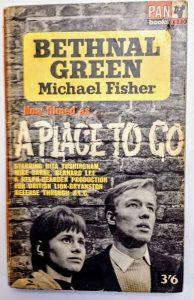
Set in London’s East End, Bethnal Green centres on Ricky Flint, a young working-class man who longs to escape the economic and social limitations of his surroundings. Disillusioned with his circumstances, Ricky becomes involved in a planned robbery, forcing him to confront questions of loyalty, ambition and personal responsibility. The novel explores working-class hardship, social entrapment and the desire for a different future against the backdrop of a changing East End community (Fisher, 1961).
🎬 A Place to Go Directed by Basil Dearden (1963)
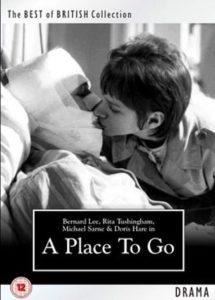
The novel was adapted into the 1963 film A Place to Go, directed by Basil Dearden. The film stars Michael Sarne as Ricky Flint, Rita Tushingham as Catherine Donovan and Bernard Lee as Matt Flint. Set against the changing landscape of Bethnal Green, the film explores working-class aspirations, social mobility and the tensions between individual ambition and community ties (BFI, n.d.; British Film Database, n.d.).
18. 📖 Life at the Top by John Braine (1962)
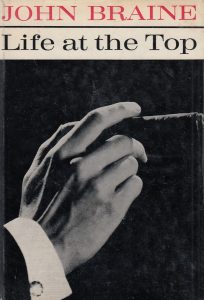
Life at the Top is the sequel to John Braine‘s Room at the Top (1957), returning to Joe Lampton approximately ten years after his earlier rise to social prominence. Having achieved the wealth and status he once desired through his marriage to Susan Brown, Joe now finds himself increasingly dissatisfied with his domestic and professional life. His marriage is troubled, his career has stalled, and the material success he once pursued so relentlessly has failed to provide the fulfilment he expected. The novel explores the disillusionment that can accompany social advancement and the personal consequences of ambition and moral compromise (Braine, 1962).
🎬 Life at the Top Directed by Ted Kotcheff (1965)
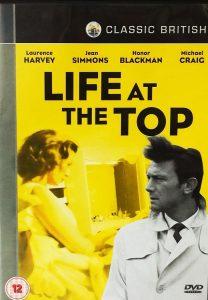
The novel was adapted into the 1965 film Life at the Top, directed by Ted Kotcheff. Laurence Harvey stars as Joe Lampton, with Jean Simmons as Susan Lampton and Honor Blackman as Norah Huxley. The film continues Joe’s story, examining his dissatisfaction with the life and social position he has worked so hard to achieve (BFI, n.d.; British Film Database, n.d.).
Through Joe Lampton’s changing circumstances, Braine examines how difficult it is to rise in society and what people actually sacrifice to become rich and powerful. The novel takes a darker look at post-war social mobility, questioning if material success actually brings happiness (Braine, 1962; British Film Database, n.d.).
19. 📖 The Boys by John Burke (1962)
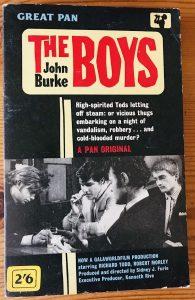
John Burke’s novelisation is based on the 1962 film of the same name. It follows four Teddy Boys standing trial for the murder of a night watchman during an attempted burglary. Through a series of differing accounts and flashbacks, the story gradually reveals the backgrounds and circumstances of the young men, encouraging the reader to consider the social influences and personal experiences that have shaped their behaviour. The novel explores juvenile delinquency, social alienation, class prejudice and the dangers of judging individuals solely by their appearance or reputation (Burke, 1962; BFI, n.d.).
🎬 The Boys Directed by Sidney J. Furie (1962)
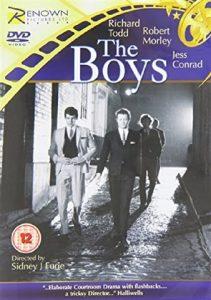
The film was directed by Sidney J. Furie and released in 1962. It stars Richard Todd, Robert Morley and Dudley Sutton, alongside a supporting cast that includes Tony Garnett. Through its courtroom drama and contrasting accounts of the events leading up to the murder, the film examines juvenile delinquency, class prejudice and the workings of the justice system (BFI, n.d.; British Film Database, n.d.).
20. 📖 The Lonely Girl by Edna O’Brien (1962)
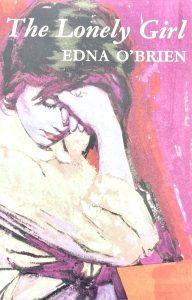
Originally published as The Lonely Girl in 1962, the novel was subsequently published under the title Girl with Green Eyes in 1964. It is the second instalment in Edna O’Brien’s Country Girls trilogy, following The Country Girls (1960) (O’Brien, 1962; British National Bibliography, n.d.).
The novel follows Kate (Caithleen) Brady and her friend Baba Brennan as they leave their rural Irish backgrounds and move to Dublin. Their experiences introduce them to a different world of relationships, independence and social expectations. Kate becomes involved with an older, sophisticated man, Eugene Gaillard, while negotiating her own identity and the tensions between traditional Irish values and personal freedom. The novel explores friendship, female independence, maturity and the changing expectations placed upon young women (O’Brien, 1962).
🎬 Girl with Green Eyes Directed by Desmond Davis (1964)
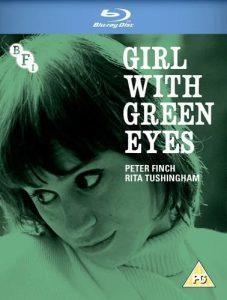
Girl with Green Eyes (1964) was directed by Desmond Davis and starred Rita Tushingham as Kate Brady, Lynn Redgrave as Baba Brennan and Peter Finch as Eugene Gaillard. The film received BAFTA nominations for Rita Tushingham and Lynn Redgrave in 1965 and went on to win the Golden Globe for Best English-Language Foreign Film (BFI, n.d.; BAFTA, n.d.; Golden Globes, 1965).
21. 📖 The Pumpkin Eater by Penelope Mortimer (1962)
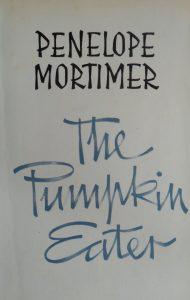
The Pumpkin Eater centres on Jo Armitage, a married woman whose increasingly troubled relationship with her husband, Jake, is compounded by the demands of motherhood and raising a large family. Feeling emotionally disconnected and overwhelmed by her domestic responsibilities, Jo struggles to make sense of her marriage and her place within it. The novel explores motherhood, marriage, female identity, emotional isolation and the pressures placed upon women by conventional domestic expectations in mid-twentieth-century Britain (Mortimer, 1962).
🎬 The Pumpkin Eater Directed by Jack Clayton(1964)
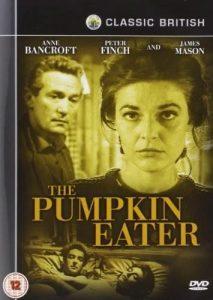
The novel was adapted into the 1964 film The Pumpkin Eater, directed by Jack Clayton, with a screenplay by Harold Pinter. The film stars Anne Bancroft as Jo Armitage, Peter Finch as Jake Armitage, James Mason as Bob Conway and Maggie Smith as Philpot. Bancroft received the Best Actress award at the 1964 Cannes Film Festival and was subsequently nominated for the Academy Award for Best Actress (BFI, n.d.; Festival de Cannes, 1964; Academy of Motion Picture Arts and Sciences, n.d.).
In both the novel and the film, marriage and motherhood are explored through the unsettling lens of the pressures placed on women in traditional family structures. Through Jo’s experiences, Mortimer challenges the idea that feeling safe and comfortable at home doesn’t automatically mean you’ll feel emotionally fulfilled (Mortimer, 1962; BFI, n.d.).
Together, these novels and their film adaptations offer a fascinating insight into a changing Britain, exploring the lives, relationships and aspirations of ordinary people against a backdrop of shifting social attitudes and expectations. What began as stories rooted in everyday experiences went on to inspire some of the most memorable and influential British films of the 1960s, leaving a lasting contribution to the country’s literary and cinematic heritage.
References
1. Books – original publications
1. Barstow, S. (1960) A Kind of Loving. London: Michael Joseph.
2. Reid Banks, L. (1960) The L-Shaped Room. London: Chatto & Windus.
3. Storey, D. (1960) This Sporting Life. London: Longmans.
4. Burke, J. (1961) The Angry Silence. London: Hodder & Stoughton.
5. Del-Rivo, L. (1961) The Furnished Room. London: Hutchinson.
6. Freeman, G. (1961) The Leather Boys. London: Anthony Blond. Published under the pseudonym Eliot George.
7. Fisher, M. (1961) Bethnal Green. Pan Books. Pan X230
8. Braine, J. (1962) Life at the Top. London: Eyre & Spottiswoode.
9. Burke, J. (1962) The Boys. London: Pan Books.
10. O’Brien, E. (1962) The Lonely Girl. London: Jonathan Cape.
11. Mortimer, P. (1962) The Pumpkin Eater. London: Hutchinson.
2. Film and historical sources
British Film Institute (BFI)
12. British Film Institute (n.d.) Where to begin with kitchen sink drama. Available at: https://www.bfi.org.uk/features/where-begin-with-kitchen-sink-drama (Accessed: 25 November 2026).
13. British Film Institute (n.d.) A Kind of Loving (1962). Available at: https://player.bfi.org.uk/rentals/film/watch-a-kind-of-loving-1962-online (Accessed: 25 November 2026).
14. British Film Institute (n.d.) This Sporting Life (1963). Available at: https://www.bfi.org.uk/film/cd6e1bfd-850d-56a6-9692-16a1d9c24c07/this-sporting-life (Accessed: 25 November 2026).
15. British Film Institute (n.d.) The Leather Boys (1964). Available at: https://www.bfi.org.uk/film/90da59ed-47a1-51f4-843a-0060514ebd64/the-leather-boys (Accessed: 25 November 2026).
16. British Film Institute (n.d.) The Boys (1962). Available at: https://www.bfi.org.uk/film/b8235d5a-51f0-5445-b051-50128d79faae/the-boys (Accessed: 25 November 2026).
17. British Film Institute (n.d.) The Pumpkin Eater (1964). Available at: https://www.bfi.org.uk/film/a56867f7-1420-5d8e-af65-6438b9d63054/the-pumpkin-eater (Accessed: 25 November 2026).
18. British Film Institute (n.d.) Girl with Green Eyes (1964). Available at: https://player.bfi.org.uk/rentals/film/watch-girl-with-green-eyes-1964-online (Accessed: 25 November 2026).
19. British Film Institute (n.d.) West 11 (1963). Available at: https://www.bfi.org.uk/lists/10-great-films-west-london (Accessed: 25 November 2026).
BAFTA
20. British Academy of Film and Television Arts (BAFTA) (n.d.) Film Awards: 1963 results. Available at: https://www.bafta.org/awards/film/?award-year=1963 (Accessed: 25 November 2026).
21. British Academy of Film and Television Arts (BAFTA) (n.d.) Film: British Actress – awards archive. Available at: https://www.bafta.org/awards/film/british-actress/ (Accessed: 25 November 2026).
22. British Academy of Film and Television Arts (BAFTA) (n.d.) Film: British Film – awards archive. Available at: https://www.bafta.org/awards/film/british-film/ (Accessed: 25 November 2026).
Berlin International Film Festival
23. Berlin International Film Festival (n.d.) Awards and Juries Archive: 1962. Available at: https://www.berlinale.de/en/archive/awards-juries/awards.html/p%3D36 (Accessed: 25 November 2026).
Festival de Cannes
24. Festival de Cannes (n.d.) The Pumpkin Eater (1964). Available at: https://www.festival-cannes.com/en/f/the-pumpkin-eater/ (Accessed: 25 November 2026).
© 2026, Jayne Thomas. All rights reserved.
Follow me :