

Meaning of The Term Kitchen Sink Realism
“Kitchen Sink Realism” is a phrase used to describe a particular genre of British film and drama that emerged in the late 1950s and early 1960s. It refers to a type of social realism that concentrates on the everyday lives of working-class people. It focuses on the everyday circumstances of working-class and lower-middle-class people. The term ‘kitchen sink’ reflects the focus on ordinary domestic life and everyday surroundings. Thus, to the extent of including the minute details of domestic life, such as the kitchen sink.

Cover artist John Minton
Published by Eyre & Spottiswoode, 1957
The Key Features of Kitchen Sink Realism
Social And Economic Issues
These works often depicted the social and economic circumstances of post-war Britain, including class differences, financial difficulties, and frustrations experienced by working-class people. They focus on the frustrations and inequalities that working-class people face.
Realistic Portrayal of Working-Class Environments
These stories are often set in working-class or lower-middle-class environments. They portray the everyday circumstances and challenges faced by their characters. These include financial difficulties, conflict within their domestic situations, and the constraints that society imposes upon them. The characters often attempt to improve or change their circumstances..
These works also portray the aspirations of people within their social class.. Examples of early works displaying this are settings or/and filming in predominantly working-class areas. For example, A Kind of Loving and Room at the Top in Yorkshire, A Taste of Honey in Greater Manchester, Saturday Night and Sunday Morning in Nottingham, and later works also set in working-class areas of London.

Published by Michael Joseph
Social Issues
Kitchen Sink Realism often addresses the social and economic circumstances faced by its characters. Common subjects include poverty, inequality, class conflict, unemployment, and personal difficulties. For example, the central character, Joe Lampton, in Room at the Top by John Braine (1957) is determined to improve his social and economic standing.
These themes are often explored through the family and relationship dynamics of the characters. They centre around their domestic situations. Depicted in A Kind of Loving by Stan Barstow (1960), where the central character Vic Brown’s relationship leads to an unplanned pregnancy and marriage, altering the course of his life. Jo in A Taste of Honey by Shelagh Delaney (1958) faces an unwanted pregnancy and has an uncaring mother. Additionally, Jo’s gay friend Geoffrey offers empathy and support for Jo.

Paperback front cover, Methuen’s Modern Plays 1959
Authentic Dialogue
The speech patterns, regional accents, and dialect used in these works contribute to their sense of realism. Saturday Night and Sunday Morning by Alan Sillitoe (1958) provides an example through the dialogue and language of its central character, Arthur Seaton.
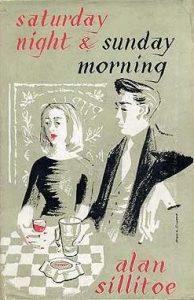
Cover artist: Mona Moore
Published by W.H. Allen Ltd
Everyday Struggles
“Kitchen Sink Realism” often portrays the ordinary pressures of everyday life. The works highlight the aspirations of working-class people. An example is the central protagonist, Jimmy Porter, in Look Back in Anger by John Osborne (1956). His frustrations are expressed through his relationships, employment, and circumstances.
There was large social change in Britain following the Second World War when these works appeared. Their settings and subject matter reflected aspects of everyday life in post-war Britain. Thus displaying an introspective desire to bring the concerns of the working class into the limelight by artistic interpretation.

Published by Faber and Faber, 1957
Characters and Aspirations
The central characters within each story often rebel against societal expectations and norms, due to them feeling trapped by their circumstances. This leads them to seek greater independence, financial security, relationships, or social mobility. Examples include Jimmy Porter and Arthur Seaton, who both express their dissatisfaction through rebellious or confrontational behaviour
The Origin of the Term Kitchen Sink Drama
The term “Kitchen Sink” did not originally refer to kitchen-sink drama at all. It came from the visual arts.
Kenneth Tynan, the English theatre critic and writer, used the phrase to describe John Osborne’s play Look Back in Anger in his influential article published in the Observer in 1956. This resulted in establishing the play’s reputation. This is considered to be fundamental in the works that followed in the Angry Young Men movement of the late 1950s and early 1960s. Kenneth Tynan observed that the play included not only the important events of everyday life, but also the more trivial aspects on stage, such as the kitchen sink.
The art critic David Sylvester used the term “Kitchen Sink” in 1954 in Encounter magazine when writing about the paintings of John Bratby and other British artists. Bratby’s paintings of everyday life and ordinary domestic interiors helped to establish the term associated with post-war British realism.
References
British Film Institute (2016) ‘Where to begin with kitchen sink drama’, BFI, 22 June. Available at: (Accessed: 19 August 2026).
Heidarzadegan, N. and Kurt Yıldız, Z. (2020) ‘Kitchen Sink Drama and Naturalism: Trends of Post-War English Theatre’, The Journal of Applied Linguistics and Applied Literature: Dynamics and Advances, 8(1), pp. 139–149. doi:10.22049/jalda.2020.26818.1172.
Tucker, D. (ed.) (2011) British Social Realism in the Arts since 1940. Basingstoke: Palgrave Macmillan.
Tynan, K. (1956) ‘Jimmy Porter, prince of scum’, The Observer, 13 May. Available at: The Guardian – Observer archive (Accessed: 19 August 2026).
© 2024 – 2026, Jayne Thomas. All rights reserved.
Follow me :