

Life at the Top by John Braine (1962) – Review & Synopsis
“Life at the Top” by John Braine was published in 1962. Continuing the story of Joe Lampton, it is the sequel to “Room at the Top”. The novel is set a decade later from where the reader left Joe Lampton in “Room at the Top”, just then embarking on the affluent life he had ruthlessly pursued.
Life at the Top by John Braine (1962) – Synopsis
Now married to Susan Brown, the daughter of the wealthy Abe Brown, Joe has achieved his goal of social mobility. He has attained financial comfort, obtained a position within Abe’s business working as a senior executive. He has accomplished the social status he sought in “Room at the Top”. Still set in the fictional northern town of Warley, Joe exteriorizes post-war social mobility. However despite his outward portrayal, he is deeply unhappy and finds himself unsettled.
His marriage to Susan has become emotionally detached and Joe feels professionally suffocated due to the domineering personality of Abe Brown. It’s here that he realises that the sacrifices he has made to accomplish success are not as he anticipated and begin to weigh heavily on him. The consequences being that Joe begins an affair with a television presenter Norah Huxley. He sees in Nora a representation of a less class restricted world. As the affair progresses Joe considers ending his marriage to Susan and leaving the life behind that he ambitiously pursued over a decade before. However in doing so, he realises he has to confront the emptiness he feels that comes with the price of chasing ambition.
To summarise “Life at the Top” by John Braine (1962) represents a significant exploration of class identity and ambition. Thus resulting in disillusionment and the emotional cost of “reaching the top” in mid-twentieth-century Britain.
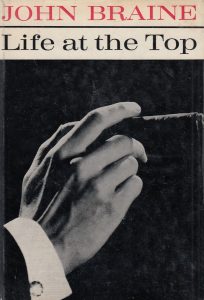
Review of Life at the Top by John Braine (1962)
John Braine’s “Life at the Top” is the sequel which revisits one of British literature’s most recognizable social climbers, Joe Lampton. Upon reading the novel, it invites the reader to ask themselves “Does achieving your goals really result in personal happiness?” In response to that question, John Braine not only gives us an insight in to the continuation of Joe’s life. He also digs deeper into the subjective cost of success, the claustrophobic restraints governed by class hierarchy and the contradiction of mid-century British society.
A Different Kind of Sequel
“Life at the Top” is not a rerun of the storyline that encompasses the grittiness of “Room at the Top”. It is a novel which has a more introspective storyline that is interspersed with a melancholic feel to it. “Room at the Top” saw the ruthlessly ambitious Joe Lampton, trampling on anyone in his path to work his way up to the top of the social ladder. Whereas “Life at the Top” is akin to Joe reaching the top of that ladder, peering downwards and comprehending that attaining and fitting into this status is actually an arrival fallacy.
At the beginning of “Life at the Top”, Joe Lampton, appears outwardly to have achieved the success that he ruthlessly pursued. A decade on he is placed firmly within the social world he once envied. Marrying Susan Brown has made sure of that. Joe now has entry to security, wealth, comfort. He has material wealth, a house and a sports car. In addition he has the respectability of his peers. He has all the things he chased so ambitiously for because he once thought this would prove he had “made it”.
A Wasteland Between Desire and Contentment
However this is when we see the truth of John Braine‘s writing kick in. We get to see for want of a better phrase “that all that glitters in not gold”. The novel does not applaud Joe ‘s success, it instead questions his success that has caused his onset of emotional disillusionment. The central focus of the story lies within the barren wasteland between him seeking desire and equally contentment.
Compromise and Class Distinction Resulting in Psychological Strain
“Life at the Top” identifies the portrayal of the pressures of class distinction that continue to remain despite material advancement. Despite acquiring money and title, this does not take away Joe’s humble working-class background. Nor does it overlook the influences that shaped him. Abe Brown, his father-in-law has an imminent presence throughout the novel. He chips away slowly at Joe’s independence. Abe dictates Joe’s professional life also.
Additionally, in social situations Joe can’t help but notice that his class and behaviour is being invisibly measured by those he comes into contact with. A pattern in these dynamics that have increased overtime is when Joe realises that he needs to confront them. Here we see John Braine increasing the psychological realism of the storyline.
Joe Lampton is now caught at a crossroads. Whilst resenting his past compromises he is equally not able to turn his back on those compromises due to the advantages of material and financial comforts that they bring him.
The Comfort of Marriage Without Connection
One of John Braine‘s writing strengths are that he is effective in writing about relationships. Examples can be seen in some of his future works. Personal favourites of mine being “Waiting For Shelia”, “One and Last Loves” and “These Golden Years” .
That same effectiveness is brought to light in “Life At The Top” regarding Joe’s and Susan’s marriage. Appearance and social status take precedent over emotional intimacy. Their conversations within the book seem superficial at the least. The silence between them speaks volumes. John Braine‘s characterisation of Susan is that she is a product of the same social system that has resulted in Joe’s emotional, social and professional suffocation. The novel is symbolic in that their marriage is based on comfort without connection.
Norah Huxley
In contrast the charismatic independent television presenter Norah Huxley, that Joe begins an affair with is very different to Susan. Nora symbolizes what Joe believes is lacking within his marriage to Susan. That being freedom and genuine emotional connection. Unfortunately for Joe this relationship adds further layers of complexity. Joe begins to question his identity and value, and ask whether his life would be fulfilled were he to turn his back on his life and begin again? Or would he be jumping out of the frying pan in to the fire and swapping one set of compromises for another? John Braine treats this quandary with subtilty and sensitivity.
Writing Style
“Life at the Top” lacks the rawness of “Room at the Top” . However this is an intentional sequel that complements the story John Braine wishes to tell. The writing is very observant regarding the class system and their social etiquette, capturing the tone of early 1960s Britain.
Also another strength of this novel is that it is not dramatized. It introduces the reader to the disillusionment that Joe feels. However the storyline and points are not laboured. The story subtly leads the reader to form this conclusion as the story progresses. In effect the novel echoes back that a sense of self can be shaped by small disappointments and unspoken resentments. Even if those upheavals, disappointments or resentments never result in a major crisis.

In Summary
“Life at the Top” is a compelling sequel to “Room at the Top”. It invites readers who would like to see how Joe’s life is after a decade. Admittedly it does not have the same appealing storyline of “Room at the Top”. However “Life at the Top” does not have the same repetitiveness of central themes like some sequels do.
John Braine’s novel is a poignant reminder that pursuing and achieving goals does not necessarily bring peace of mind. Also that unexpected emotional cost can be a result of upward mobility. For readers interested in Kitchen Sink Realism, class, identity and ambition, “Life at the Top” is a thoughtful read highlighting how success can be both a goal and personal achievement but can equally also become a trap with emotional and personal ramifications.
Reference List
Braine, J. (1962). Life at the Top. Eyre & Spottiswoode
Braine, J. (1983). Life at the Top. Methuen
© 2026, Jayne Thomas. All rights reserved.
Follow me :