

Room at the Top by John Braine (1957) – Review & Synopsis
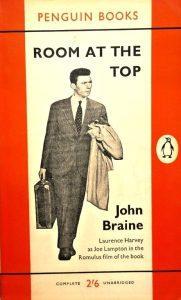
Room at the Top was published in 1957 by Eyre & Spottiswoode and was John Braine’s first novel. (Braine, 1957)
The protagonist of the story centres on the upwardly mobile Joe Lampton. Joe has one ambition, and that is to climb the social ladder from his humble beginnings. He desires to achieve what he deems to be socially acceptable success.
Synopsis of Room at the Top by John Braine (1957)
The novel begins with Joe moving to the fictional industrial town of Warley in Yorkshire. Here Joe rents a room in a more affluent part at the top of Warley. Hence the title given to the novel, Room at the Top by John Braine. (British National Bibliography, n.d.)
His sole ambitions are based significantly on entering the world of business to acquire wealth. Joe is from a working-class background and has moved to Warley because he has gained a position as a clerk in the town’s finance department at the town hall. Warley is a fictional town; however, the novel draws on the industrial West Yorkshire settings that are familiar to John Braine. Deeply ingrained in Joe are his working-class beginnings. He is a working-class young man seeking upward social mobility. And regardless of who he tramples on, he’s ruthlessly determined to climb the economic and social ladder. (Braine, 1957)

Published by Eyre & Spottiswoode, 1957.
Ambition Takes Precedent In Joe Lampton’s World
After settling in lodgings, he joins the local amateur dramatics society. It is here he is drawn to Susan Brown, the daughter of a wealthy industrialist. Joe is calculating in many respects. He visualises his pursuing of Susan to be his stepping stone to a middle-class life. Plus, the social standing he craves. However, at the same time he also begins an initial platonic friendship, also at the local amateur dramatics meetings, with a childless, unhappily married and somewhat older woman, Alice Aisgill. (Braine, 1957)
Eventually his friendship with Alice develops into a passionate love affair. His affair with Alice is one which develops into a genuine love. Unfortunately and predictably, Joe is internally conflicted and torn between his unrelenting ambition of social aspiration and his genuine love for Alice. (Braine, 1957)
Due to Joe’s ambitions and choices giving rise to his internal conflict, it is evident how much Alice and he have an intense and genuine love. However, he also knows that Susan characterises the upward mobility he craves. The tragic and deeply emotional culmination of consequences that Joe Lampton faces based on his decisions in Room at the Top accentuates the telltale signs of the emotional cost and moral expense of chasing ambition. Sadly being at the detriment of genuine emotional love and human connectivity. (Braine, 1957)
The novel Room at the Top portrays to the reader that there is a moral price to be paid when individuals put an emphasis on climbing the ladder of social mobility and when ambition takes precedence. (Braine, 1957)
Review of Room at the Top by John Braine (1957)
As with many of John Braine‘s novels, he is direct and straight-talking. He demonstrates the often raw yet vulnerable complexities that we as human beings are composed of. Room at the Top is one of the groundbreaking novels of its time in the genre of literature penned by the “Angry Young Men” movement. Thus, following the success of Room at the Top, John Braine is associated with the group of writers. It is thought of as one of the benchmarks of this genre of literature. It brings to the forefront the debatable and controversial issues of social mobility of the working classes in post-war Britain. (Lee, 2024)
The Charismatic and Manipulative Side of Joe Lampton
Joe Lampton initially comes across as a likeable character due to his charisma. However, unfortunately, he displays characteristics of moral ambiguity. His character also comes across in the novel as arrogant and, in some ways, that of a snob. The telltale signs are evident in the novel. And they are even more evident when he discusses how he has a numerical ranking scale for men as well as their female partners, which is dependent on their career status.
Joe is also manipulative towards both Susan and Alice. Although Alice is more mature, she is somewhat more aware of this. Joe is emotionally flawed and insecure. The causative effect is due to his perception of “wanting to be someone” due to his humble upbringing. He desires to do better, to have a better start and a better social status. I am sure readers can empathise with this in Room at the Top or those who have seen the film. However, unfortunately, there is a high price to pay for this. Due to the fact that it has the potential to damage personal relationships. John Braine explores this in Room at the Top.
Joe Lampton’s Pursuit of Financial Success
Personally, I feel that this is an unlikeable character trait of Joe Lampton, or of any human being for that matter. However, what it does show is that Joe is insecure within himself. He is so desperate to leave behind his working-class background. So in some ways I feel some empathy towards his character, because of his inner conflict and his personal insecurities.
However, he is trying to take a shortcut in the pursuit of financial stability and to attain success. It’s without doubt that this is not how life works. Unless, of course, moral fibre is lacking, scruples are thrown through the window, and those who do so are happy to trample on anyone in their path. Which, in the long run, does not conclude in a happy life. Nor does it ever end well.
The Compromise of Morality Over Ambition
Room at the Top not only explores the constraints and personal sacrifices within relationships to attain success. The novel in turn questions the compromises of morality over ambition. Also exploring how the effects of the social class hierarchy have an effect on personal relationships. It is without doubt that whilst Joe Lampton appears to be charismatic with an air of arrogance, underneath his veneer, he is somewhat emotionally hollow. This is due to his desire to become materially successful. The consequence being that it exposes the challenges of the loneliness he feels.
The Gender Roles of Women Within a Patriarchal Society
Whilst the novel concentrates on Joe Lampton as the central character, it is evident to me as the reader that there too is another takeaway theme. Both Susan and Alice are, in effect, pawns in Joe’s game. I have read Room at the Top three times over the course of forty years, and what I find resonating every time is the way both Alice and Susan were perceived and treated by Joe.
I personally like the character of Alice Aisgill, as I think she is depicted as quite a strong woman. Unfortunately, her heart rules her head as far as Joe is concerned. Susan, on the other hand, is very young. I can’t help but feel that her middle-class, sheltered upbringing further facilitates Joe’s manipulation of her. Alice is more street-wise; Susan isn’t.
The novel (although I am unsure if this was a theme that John Braine chose to consciously include whilst writing) demonstrates gender roles of women within a patriarchal society. Indeed giving us insight into how society’s view of the roles of women over the course of nearly seventy years has evolved.
A Personal Reflection: October 1985
Room at the Top by John Braine is one of my top favourite reads of the Kitchen Sink Realism genre of literature. It is an important early novel associated with Kitchen Sink Realism, which contributes to the development of the social-realist tradition.
Also, it incidentally is my all-time favourite film. I generally read a novel before watching the accompanying film. However, on an Autumnal October evening in 1985, Room at the Top was televised. I was completely mesmerised by the film. Within a week I had acquired the novel, and within a fortnight I had read it, along with the sequel Life at the Top.
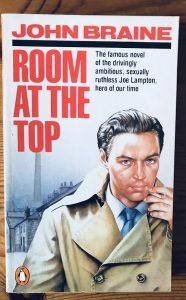
Coincidentally, in the not too far distant future, after reading the novel, I was to realise on the local grapevine that John Braine had worked as a librarian at Darton Library. Darton is a village on the outskirts of Barnsley and approximately six miles from where I originate. The Yorkshire Post‘s article, in an interview given in 2006 by Roger Ratcliffe, notes that John Braine‘s Room at the Top was published in March 1957. Additionally, this was whilst he was working as a librarian at Darton Library and living in nearby Wakefield.
Why It Resonates
The film’s stark portrayal of social mobility and the raw ambition of Joe Lampton resonated deeply. The film adaptation was directed by Jack Clayton. Starring Laurence Harvey, Simone Signoret and Heather Sears, it is hugely important within the story of British New Wave cinema. The BFI describes it as an early flagship of the British New Wave. (BFI, n.d., Scovell, 2023, Taylor 2026)
So yes, I have a soft spot and fondness for this novel and film for several reasons. For the nostalgia it evokes. Equally, the backdrop of locations in the novel and film. And a fond time in my life reading the novel and also viewing the film. I was at that time embarking on sitting my O’Levels, looking forward to beginning sixth form college the following Autumn. I had just turned sixteen, which seems almost a lifetime ago now.
Equally important, however, is the large impression it had on me alongside a handful of other novels of the Kitchen Sink genre. It was one of the major catalysts that sparked my lifelong hobby of reading this genre of books. The novels I could then relate to, and even more so now as I am much older.
Now : 2026
Decades later, the academic significance of John Braine’s work continues to be discussed because of it’s importance in highlighting regional identity, class consciousness, and post-war British social realism. (Lee, 2024)
The transition from a student captivated by the Angry Young Men movement to a lifelong collector and reader of Braine’s entire bibliography has only intensified my appreciation for his writing. The themes of class consciousness and regional identity that he explored from a small library desk continue to offer heartfelt insights into the British social landscape, notably more so that I relate to South Yorkshire, where I originate.
Interview of John Braine Discussing Room at the Top
Here is an original interview with John Braine by Studs Terkel from April 14th 1959. It is owned by the Chicago History Museum. John Braine discusses class distinction, the development of the characters, and his writing of Room at the Top. Also, he discusses the film adaptation of Room at the Top by Jack Clayton, released in 1959, as well as touching on the definition of the Angry Young Men movement and the Beat Generation literary and cultural movement. This is one of a handful of rare original audio/video interviews given with John Braine that are now available online and is a fascinating listen. “Life at the Top” by John Braine (1962) was the sequel, which follows the life of Joe Lampton one decade later.
The Legacy of a Literary Giant
The novel and film Room at the Top is a powerful and critical exploration of the social class hierarchy and the moral challenges in pursuit of social mobility in post-war Britain. Its key themes also result in making the novel a prominent work in post-war British literature. Additionally being relatable to readers who identify with similar ambivalence towards the class system versus ambition.
John Braine’s position as an essential foundation of post-war British realism is undeniable. Reflecting on his journey—and my own lifelong connection to his work—reveals a story that spans across the mid-century “kitchen sink” drama. Braine’s influence within his writing is unwavering and is why his voice remains a vital study for anyone interested in the convergence of local identity and national literature.
To conclude, from my perspective, Room at the Top is a deeply thought-provoking and brilliantly written novel by John Braine. The takeaway caveat of the novel Room at the Top suggests and forces the question, is should we, as individuals, pay such a high price for the strive of personal success? Be that financially or socially? Despite this being at the detriment of the personal cost towards our happiness, relationships, and a peaceful life. Ultimately, this is a personal choice for us as individuals and a question we should often ask ourselves.
References
Braine, J. (1957). Room at the Top. London: Eyre & Spottiswoode.
British Film Institute (BFI) (n.d.) Room at the Top (1958). Available at: BFI – Room at the Top (Accessed: 19 August 2026).
Scovell, A. (2023) ‘Room at the Top: in search of the Bradford locations for a British New Wave classic’, BFI, 17 July. Available at: BFI article – Room at the Top (Accessed: 19 August 2026).
Taylor, B.F. (2026) ‘A cinema of surfaces: Jack Clayton’s Room at the Top’, in The British New Wave: A certain tendency?, pp. 69–89. Manchester: Manchester University Press. Available at: Cambridge University Press – chapter information (Accessed: 19 August 2026).
Lee, S. (2024). The Intersection of Class and Space in British Postwar Writing: Kitchen Sink Aesthetics. London: Bloomsbury Academic.
Ratcliffe, R. (2006, 27 October). John Braine’s fall from the top. The Yorkshire Post. Archived from the original on 29 May 2016. Retrieved on 10 January 2026.
© 2025 – 2026, Jayne Thomas. All rights reserved.
Follow me :