

Life at the Top by John Braine (1962) – Review & Synopsis
Life at the Top by John Braine was published in 1962. It is the sequel to Room at the Top (1957) and continues Joe Lampton’s story about ten years later. Joe has achieved the affluent lifestyle he once pursued, but finds that his new circumstances have not brought the happiness he expected (Braine, 1962).
Life at the Top on Film
The novel was adapted for the cinema in 1965, with Laurence Harvey reprising his role as Joe Lampton from Room at the Top. The film further connects Braine’s novel to the Kitchen Sink films of the period (Reelstreets, 2026).
Life at the Top by John Braine (1962) – Synopsis
Now married to Susan Brown, the daughter of wealthy businessman Abe Brown, Joe has achieved the social mobility he sought in Room at the Top. He has financial security and works as a senior executive in Abe’s business. Still living in the fictional northern town of Warley, Joe appears to have achieved the success he once wanted. However, beneath this outward success, he is increasingly unhappy and unsettled.
His marriage to Susan has become emotionally detached, and Joe feels professionally suffocated due to the domineering personality of Abe Brown. It’s here that he realises that the sacrifices he has made to accomplish success are not as he anticipated and begin to weigh heavily on him.
This results in Joe beginning an affair with television presenter Norah Huxley. He sees in Nora a representation of a less class-restricted world and the dissatisfaction of his marriage and established life. As the relationship develops, Joe considers leaving Susan and the life behind that he ambitiously pursued over a decade before. However, he is forced to confront the emptiness he feels that comes with the price of chasing ambition.
To summarise, Life at the Top by John Braine (1962) represents a significant exploration of class identity and ambition. Thus resulting in disillusionment and the emotional cost of “reaching the top” in mid-twentieth-century Britain (Braine, 1962; Clarke, 2015).
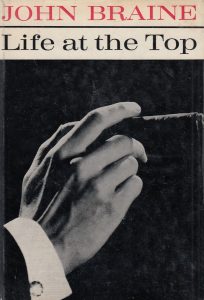
Review of Life at the Top by John Braine (1962)
John Braine’s Life at the Top is the sequel that revisits one of British literature’s most recognizable social climbers, Joe Lampton. Upon reading the novel, it invites the reader to ask themselves, “Does achieving your goals really result in personal happiness?” In response to that question, John Braine not only gives us insight into the continuation of Joe’s life. He also digs deeper into the subjective cost of success, the claustrophobic restraints governed by class hierarchy, and the contradiction of mid-century British society.
A Different Kind of Sequel
Life at the Top takes a different approach to the storyline and the grittiness of Room at the Top. It is a novel that has a more introspective storyline that is interspersed with a melancholic feel to it. Room at the Top saw the ruthlessly ambitious Joe Lampton, trampling on anyone in his path to work his way up to the top of the social ladder. Whereas Life at the Top focuses on Joe reaching the top of that ladder, peering downwards and comprehending that attaining and fitting into this status is actually an arrival fallacy.
At the beginning of Life at the Top, Joe Lampton appears outwardly to have achieved the success that he ruthlessly pursued. A decade on, he is placed firmly within the social world he once envied. Marrying Susan Brown has made sure of that. Joe now has access to security, wealth, and comfort. He now has the house, cars, financial security, and social position that once represented success to him.
Disillusionment and Ambition
However, this is when we see the truth of John Braine‘s writing kick in. We get to see, for want of a better phrase, “that all that glitters is not gold”. Despite his material success, Joe remains dissatisfied with his life. The novel explores the gap between the ambitions he once had and the reality of living with the consequences of achieving them.
Class and Social Mobility
Life at the Top continues Braine’s exploration of class and social mobility. Although Joe has acquired wealth and social status, his working-class background remains an important part of his identity. Nor does it overlook the influences that shaped him. His father-in-law, Abe Brown, continues to exert considerable influence over Joe, both personally and professionally. He chips away slowly at Joe’s independence. Abe dictates Joe’s professional life also.
Joe remains conscious of the differences between himself and the social world he has entered. Although he has acquired wealth and status, he remains aware of the attitudes and expectations associated with his working-class background. A pattern in these dynamics that has increased over time is that Joe realises he needs to confront them.
Joe Lampton is now caught between two worlds. Increasingly dissatisfied with his past compromises, he is reluctant to give up on the financial security and social position he has achieved (Clarke, 2015).
The Comfort of Marriage Without Connection
One of John Braine‘s writing strengths is that he is effective in writing about relationships. Examples can be seen in some of his future works. Personal favourites of mine are Waiting for Sheila, One and Last Loves, and These Golden Years.
That same effectiveness is brought to light in Life at the Top regarding Joe’s and Susan’s marriage. Appearance and social status take precedence over emotional intimacy. Their conversations within the book seem superficial at the least. Joe and Susan’s marriage is increasingly distant. Their comfortable lifestyle does not necessarily translate into emotional closeness, and their relationship becomes another indication of the dissatisfaction underlying Joe’s apparently successful life.
John Braine‘s characterisation of Susan is that she is shaped by the social environment that has resulted in Joe’s emotional, social and professional suffocation. Their marriage is affected by expectations surrounding wealth, respectability and social position, as well as by their growing emotional distance. Thus, the novel is symbolic in that their marriage is based on comfort without connection.
Norah Huxley
In contrast, the charismatic independent television presenter Norah Huxley, who Joe begins an affair with, is very different from Susan. Nora symbolizes what Joe believes is lacking within his marriage to Susan. This being freedom and genuine emotional connection. Unfortunately for Joe, this relationship adds further layers of complexity. Joe begins to question whether leaving his marriage and starting again would provide the fulfilment he wants. The novel also raises the possibility that changing his circumstances may not necessarily resolve the dissatisfaction he feels. John Braine treats this quandary with subtlety and sensitivity.
Writing Style
Life at the Top has a different tone from Room at the Top. While the earlier novel focuses strongly on Joe’s ambition and social advancement, the sequel is more concerned with the consequences of the life he has created. The writing is very observant regarding the class system and its social etiquette, capturing the tone of early 1960s Britain.
Another strength of this novel is that it does not rely entirely on dramatic events. It introduces the reader to the disillusionment that Joe feels. However, the storyline and points are not laboured. The novel allows the changes in Joe’s relationships, ambitions, and outlook to develop through the story (Braine, 1962).

A Personal Perspective
Then (October 1985):
At sixteen, watching Room at the Top completely changed everything for me. Growing up in Barnsley and living just six miles from Darton Library—where John Braine himself used to work—Joe Lampton’s world felt so real and close to home. Back then, surrounded by the gritty, industrial heart of South Yorkshire and the landscapes of Kes, Joe’s fearless ambition felt like a direct reflection of the world around me. It was the spark that ignited my 40-year love affair with Kitchen Sink Realism.
Now (2026):
Revisiting Joe’s journey today in the sequel, Life at the Top, hits a completely different chord. After living in Nottingham for 31 years, within walking distance of historic spots like Salisbury Street, the old Raleigh Factory, and the White Horse pub, I look at his “arrival” at the top with much more mature, nostalgic eyes. Joe has the sports car and the big house, but he feels the heavy weight of losing his real identity. It reminds me that no matter how far we travel or what we achieve in our adult lives, our hearts are always anchored in the places and working-class roots we started from.
Conclusion
Life at the Top provides a continuation of Joe Lampton’s story ten years after Room at the Top. It presents a very different stage of his life, examining what happens after he has achieved the social and financial position he once wanted.
Life at the Top is a wonderfully nostalgic bond that connects to my own life story. It loops all the way back to when I was a 13-year-old schoolgirl at Willowgarth High School, discovering Granada’s A Kind of Loving on the screen and sitting in my English Lit class with a teacher whose further encouragement for my love of reading Kitchen Sink Realism stayed with me throughout my adult life. If you’ve spent years loving the unpolished truth of Barry Hines or Alan Sillitoe, this novel is the perfect connection.
John Braine’s novel is a poignant reminder that pursuing and achieving goals does not necessarily bring peace of mind. Also, unexpected emotional cost can be a result of upward mobility. For readers interested in Kitchen Sink Realism, class, social mobility and ambition, Life at the Top provides a further look at the changing social landscape of Britain in the early 1960s. It takes us past the initial, hungry rush of youth and looks delicately at the “morning after”—asking us what happens when we finally get what we thought we wanted, and how we find our way back to who we truly are.
Reference List
Braine, J. (1962). Life at the Top. Eyre & Spottiswoode
Braine, J. (2015). Life at the Top. With an introduction by Ben Clarke. Richmond, VA: Valancourt Books.
Reelstreets (2026) Life at the Top, available at https://www.reelstreets.com/films/life-at-the-top/
© 2026, Jayne Thomas. All rights reserved.
Follow me :